Playbooks
One Job, Everywhere
The Rule
Section titled “The Rule”A service business does five to fifteen jobs a week. Every one of those jobs is a piece of marketing content that already exists — the work is done, the result is visible, the photo takes four seconds. And almost none of it ever gets published anywhere.
The reason is not laziness. The reason is that publishing one job to three places is three separate chores, each with its own login, its own format, and its own writing task. Nobody who spends the day installing water heaters is going to open Google Business Profile, write a 200-word post, resize a photo, then do it again on Facebook, then email their web guy about adding it to the site. So the photos sit in a camera roll and the business stays invisible.
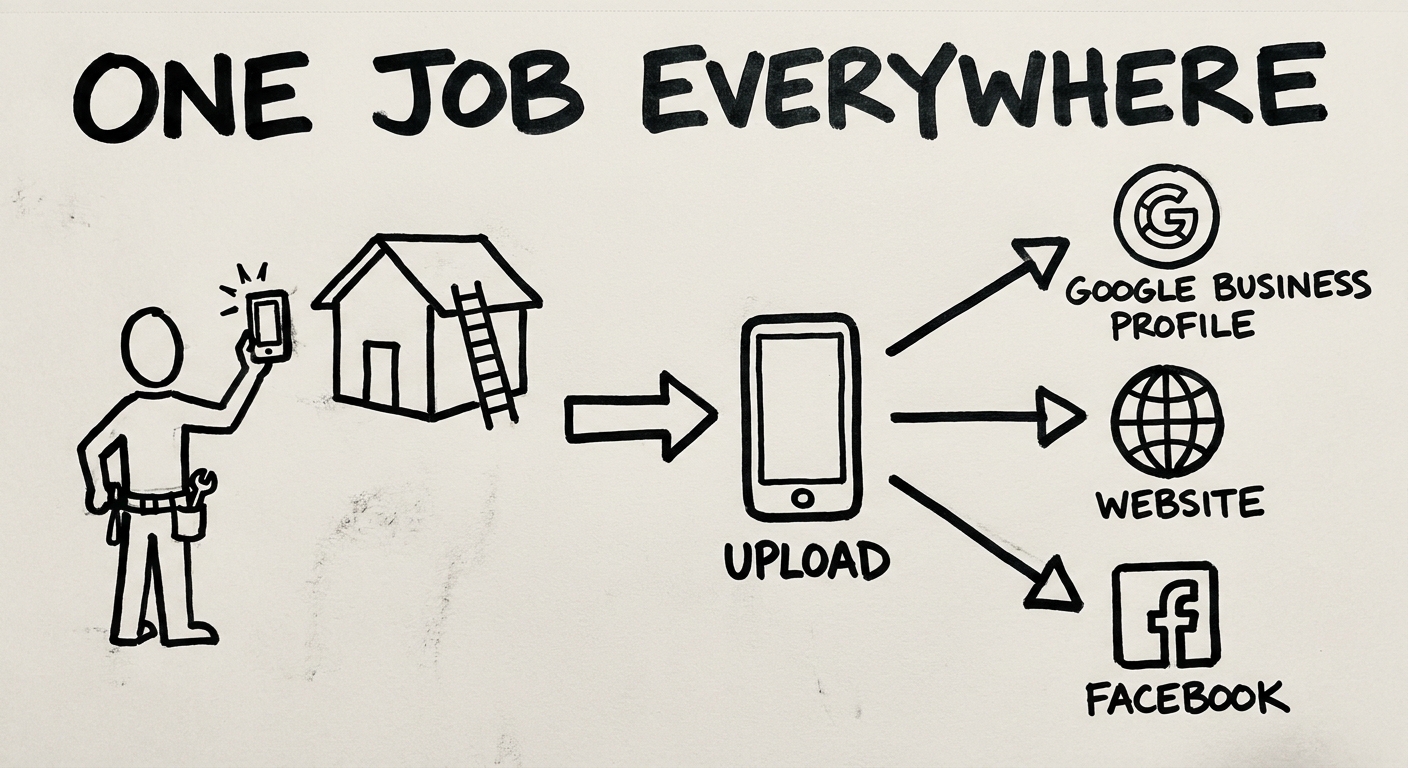
The play is to collapse three chores into one: upload once, publish everywhere.
The Asymmetry Nobody Notices
Section titled “The Asymmetry Nobody Notices”Content marketing advice assumes you have to invent content. A service business does not. They generate proof of work every single day, and proof of work is the highest-converting content there is. A before-and-after of a rebuilt deck outperforms any blog post that business could ever write.
So the constraint is not “what do we post.” The constraint is purely mechanical: getting the thing that already happened onto the three surfaces where it matters. Solve the mechanics and the content problem solves itself, forever, without anyone becoming a writer.
The Three Surfaces
Section titled “The Three Surfaces”Google Business Profile. The one that actually drives calls. Google rewards recency and activity on a profile, and photos attached to a real job in a real city feed the local relevance signal. This is the surface most service businesses ignore completely, and it is the one closest to the money.
The website. Where a project photo becomes a permanent, indexable page tied to a service and a city. Google Business Profile posts expire. A page does not. This is the compounding surface — every job makes the site a little bigger and a little more specific.
Facebook. The social proof surface. Nobody finds a handyman by searching Facebook, but plenty of people decide on a handyman by scrolling his page and seeing eleven finished jobs from the last two months. Facebook does not generate the lead, it closes the doubt.
Three surfaces, three different jobs. Same raw material.
The Play
Section titled “The Play”The owner or the tech finishes a job and opens one page on their phone. In our build, that is allthingshandyutah.com/upload/ — a single mobile-first form behind a login. Tap to take photos or pick them from the camera roll, choose the job type, say what happened, name the city. Submit.
Everything after that is automatic. The photos land in staging. AI reads the images, works out what the job was, detects before-and-after pairs, picks the hero shot, and renames the files to something search engines can use — IMG_2946.jpeg becomes swing-set-assembly-benjamin-utah-completed-front-1.jpg. Then it reads the existing website and decides where this job actually belongs, rather than blindly creating a new page. Sometimes the answer is “the assembly service page has no project photos, put it there.”
Out the other side come three drafts, one per surface, each written in the right format and length for where it is going. Those drafts land in an email with the photos attached and an approve button next to each platform. Tap Google, tap Web, tap Facebook. Anything you do not approve simply does not ship.
The whole loop for the person doing the work is: take photos, describe the job, tap approve later. That is it.
Why It Works
Section titled “Why It Works”It matches the moment. The upload happens standing in the driveway with the truck still loaded, when the photos are on the phone and the job is fresh. Any workflow that requires sitting down at a desk later will not happen, because later never comes.
It removes the writing. The reason service businesses do not post is that posting means writing, and writing is the part they hate. Take the writing out and the objection disappears entirely.
Approval keeps the owner in control without making them do the work. This is the part that makes it sellable. The owner is not handing their brand to a robot — they see every draft before anything goes live, and rejecting is one tap. But they never face a blank text box.
One input, three outputs, is a permanent multiplier. Every additional surface you wire in costs the business nothing extra. Add Instagram, add Nextdoor, add a monthly email — the tech still just takes photos in a driveway.
Common Mistakes
Section titled “Common Mistakes”Auto-publishing with no approval gate. Tempting, and wrong. One bad AI description on a live Google Business Profile costs more trust than the whole system saves in effort. The tap is cheap. Keep it.
Creating a new page for every job. This is how you end up with 400 thin pages and a website Google stops taking seriously. Most jobs should strengthen a page that already exists. Only genuinely new service-plus-city combinations deserve their own page.
Leaving the camera-default filenames. IMG_2946.jpeg tells a search engine nothing. Renaming the file to describe the job and the city is nearly free and it is one of the few image SEO signals that still counts.
Making the upload form ask too much. Every field is a reason to skip it. Photos, job type, what happened, city. Anything else can be inferred, and if it cannot be inferred it probably does not matter.
Selling it as “AI content.” Nobody wants AI content. They want their finished work to show up where customers look. Sell the outcome, not the mechanism.
Where This Goes
Section titled “Where This Goes”This is a productized service, not a one-off. The build is generic — the only per-client pieces are the upload page, the website connection, and the social accounts. Once the pipeline exists, onboarding a new home service business is configuration, not development.
It is also the most defensible kind of retainer there is. The client is not paying for posts, they are paying for a machine that turns work they were already doing into marketing they were never going to make. Cancel it and the camera roll goes quiet again.
Related
Section titled “Related”- Rank Inside the Thread — the other half of local visibility, for the searches your own pages will not win
- Link in Bio Play — where the Facebook side of this should point once someone is interested
- The Double Group Method — the audience structure this content can feed