Playbooks
The Link in Bio Play
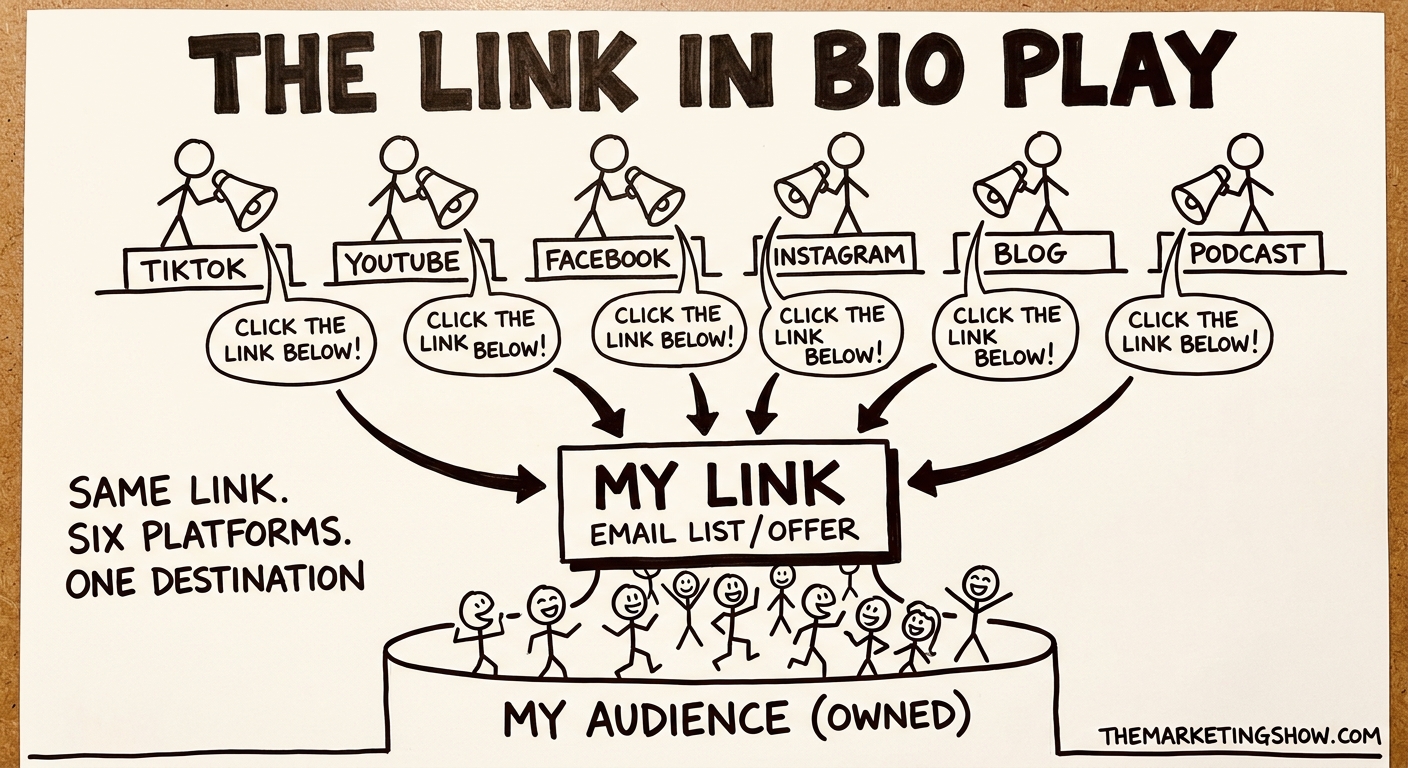
What It Is
Section titled “What It Is”Every social platform owns the relationship you have with your audience. TikTok followers, YouTube subscribers, Facebook friends, Instagram followers — none of them are yours. The platform can nuke your account, throttle your reach, or change the rules tomorrow, and the audience goes with it.
The link in bio (or description, or pinned post, or wherever a given platform lets you put one) is the one escape hatch each platform reluctantly provides. It is the bridge from rented land to owned land. Every piece of content across every platform points at the same link, and the link points at something you actually own — an email list, a landing page, a site you host.
One link. Every platform. Every post.
When To Run It
Section titled “When To Run It”- You are posting content on two or more platforms. If everything lives on one channel, the link is still useful but the compounding effect does not kick in until there is cross-platform spread.
- You have something owned on the other end of the link. An email signup, a lead magnet, a product page — not just a link to another social profile. The whole point is to move traffic to something the platform cannot revoke.
- You have a reason to send traffic. If the destination is weak, the play fails on arrival even if the CTA is perfect. Fix the destination before running it.
If the offer on the other end is still in draft, the link should still point at an email opt-in. Never let the link rot.
The Steps
Section titled “The Steps”- Pick one destination. One link. Not a different link per platform, not a different link per launch. One. Typically an email opt-in page on your own domain. The reason for one: attention is fragmenting enough without you fragmenting it further yourself.
- Update every bio, description, and pinned slot. TikTok bio, YouTube channel description, Facebook intro, Instagram bio, LinkedIn, Twitter/X, Threads, podcast show notes, blog sidebar, email signature. Anywhere the platform allows a link, put the link.
- End every piece of content with a verbal CTA. “Click the link in my bio” for Instagram. “Link in the description below” for YouTube and TikTok. “Link in the pinned comment” for Facebook posts. The data is clear on this: people do not click links unless they are told to. Even regulars forget.
- Add UTM parameters per platform. Same link, different tagging.
?utm_source=tiktok,?utm_source=youtube, etc. So arrival attribution is clean and you can see which platform is actually driving signups. - Route all traffic to the same endpoint. The landing page does not need six versions. Segment after opt-in via the UTM tag or the referring content.
- Only change the link when the destination changes. Not when a new launch drops. If you are promoting something new, promote it on the landing page the link already points at. The link is a stable address, not a campaign slot.
Why It Works
Section titled “Why It Works”- Platforms are rented land. You do not own the follower graph on any of them. An email address on your list is a direct line that no platform can throttle or revoke.
- Breakouts compound. When a video goes viral on TikTok, the link in your bio is already there. You do not need a campaign to capitalize on a spike — the funnel is always on.
- Cross-platform branding stays coherent. Someone who sees you on YouTube, then TikTok, then a blog post encounters the same link every time. That repetition is a trust signal. Different links per platform fragment the brand.
- One destination means one thing to optimize. All effort on the landing page pays off across every platform simultaneously. A 5% improvement in conversion lifts TikTok, YouTube, Facebook, and the blog all at once.
- Platforms tolerate it. They do not love outbound links, but none of them ban a link in bio. The rule has been stable for years — it is a safe, predictable channel.
Common Mistakes
Section titled “Common Mistakes”- A different link per platform. Fragments attention, fragments analytics, fragments the landing-page optimization feedback loop. One link.
- Changing the link for every launch. The link should be stable. If a launch needs promotion, promote it on the page the link already points at — do not rotate the link itself.
- No verbal CTA. Putting the link in the bio and assuming viewers will find it is wishful thinking. End every video, every post, every description with “click the link.” Even a ten-year-old audience needs reminding.
- Weak destination. A link pointing at a homepage with no opt-in is a wasted click. The destination should have one job: collect the email or the next action.
- Using a link aggregator as the destination. Linktree and its clones turn the one-link play into a seven-link play. The viewer lands on a list, has to re-decide what to click, and most leave. Skip the aggregator. Point directly at the one thing that matters most.
- No UTM attribution. Without source tagging, you cannot tell which platform is actually driving signups. Guessing wastes energy.
Related
Section titled “Related”- The Facebook Group Email Collector — the inside-Facebook version of the same play, capturing emails at the group join gate
- The Comment Ladder DM Technique — how to convert the link-clickers once they have opted in