Playbooks
The Facebook Group Email Collector
What It Is
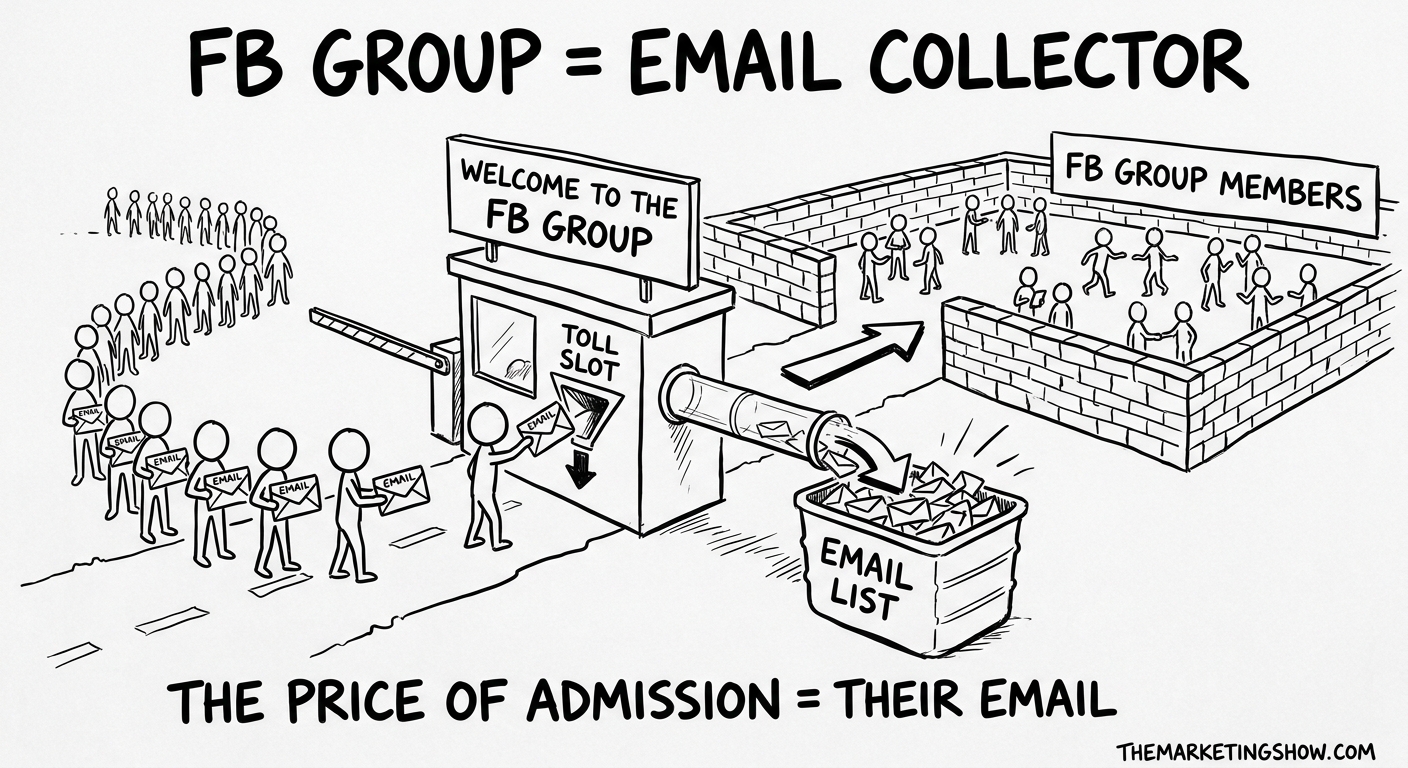
Section titled “What It Is”Facebook group admins can require join-request questions before approving a new member. Most admins use those slots for rules-compliance theater. The actual play: make the first question “what is your best email?” and treat the group gate as a toll booth. Every joiner hands over an email. The group itself becomes the opt-in — no ads, no landing page, no lead magnet needed.
The bonus layer is segmentation. The second and third question slots can sort joiners by buying intent (“where are you at with {topic}?”) so the email list routes directly to matching offers — affiliate, service, newsletter, whatever applies.
Email collection is the main play. Segmentation is a free upgrade.
When To Run It
Section titled “When To Run It”- You own or co-admin a Facebook group. The technique does not work on groups you do not moderate — you need approval authority.
- The group topic aligns with at least one paid or affiliate offer. If the group is about “AI for Entrepreneurs” and an affiliate offer is a CRM tool, the segmentation question can ask about their current CRM stack. If the offers and the group topic do not align, the segmentation layer is wasted.
- You are willing to actually use the email list. Collecting emails and never mailing them is a list of strangers. The technique assumes there is a follow-up system on the other side.
Do not bother if the group is tiny and growing slowly. The math only works when there is meaningful inbound.
The Steps
Section titled “The Steps”- Enable membership questions. In the FB group admin panel: Admin Tools → Membership Questions → turn on required questions.
- Make the first question the email ask. Exact phrasing that tests well: “Enter your best email to be approved. You can always unsubscribe later.” The permission-and-reassurance framing lifts opt-in willingness.
- Add a segmentation question for question 2 (optional but recommended). Frame it around current state, not intent. “Where are you at with {topic}?” with an open text field. Open text beats multiple choice because the language people use to describe their own situation is more honest than any label you would hand them.
- Set up extraction. Three paths, roughly in order of effort: copy manually on approval, hand it to a VA, or run a Chrome extension that does it automatically. The automated path is described below.
- Pipe into the ESP. Extracted emails flow into the appropriate list in GHL (or Mailchimp, ConvertKit, whatever). Tag by group name so attribution is clean later.
- Segment on ingest. If using a segmentation question, parse the answer and apply tags —
ghl-current-user,ghl-considering,ghl-migrating, etc. Tags become audience filters for campaigns. - Approve the joiner. Only approve after extraction so no one slips through without being captured.
Question Design
Section titled “Question Design”The questions have to earn their slot. Examples pulled from a real group (AI for Entrepreneurs, 277k members, HighLevel-adjacent audience):
| Question | Purpose | Why It Works |
|---|---|---|
| ”Enter your best email to be approved. You can always unsubscribe later.” | Email capture | Permission-forward, removes friction. Explicit reversibility signal. |
| ”Where are you at with using HighLevel Marketing Automation Software?” | Segmentation by buyer state | Open text. Answers like “I use another software but need help migrating” self-identify as affiliate-ready. |
| ”How did you hear about this group?” | Attribution | Lowest-value slot but useful for understanding which channels drive joins. Optional. |
| ”Do you agree to the group rules?” | Compliance theater | Burns a question slot on nothing. Skip unless rules compliance is a real concern. |
The rule: every question should either capture (email) or segment (current state). Rules questions and generic “how’d you hear” slots are low-value. Four question slots means four shots — use them.
Automating the Extraction
Section titled “Automating the Extraction”The manual version works but does not scale. The automated version is a Chrome extension in ~/apps/fb-email-slurper-3000/ that handles the end-to-end flow while the admin sits in the Facebook membership queue.
What it does on each join request:
- Scrapes the visible card — name, profile URL, user ID, photo, question answers, mutual friends, groups in common, location, education, work history, account age
- Optional deep-scrape opens the applicant’s profile in a background tab to pull bio, birthday, social links, hobbies
- Scores the lead 0-100 based on configurable rules
- Creates a full GoHighLevel contact with around 50 custom fields populated under an
FB Infogroup - Uploads the profile photo to the contact
- Adds the contact to the configured pipeline stage
- Drafts a personalized welcome email using
claude -p(the local Claude Code CLI, no paid API spend) - Shows a live overlay panel with stats and activity as you approve
The manual flow gets you an email. The automated flow gets you a CRM contact with 50 fields of context, a lead score, a pipeline stage, and a pre-drafted welcome email already sitting in GHL when you click approve. Worth the setup for any group with meaningful inbound.
Why It Works
Section titled “Why It Works”- The group itself is the opt-in offer. The joiner already decided they want in before they see the questions. Opt-in friction is near zero compared to a cold landing page.
- Intent is pre-qualified. Anyone raising a hand at a topic-specific group has self-selected as interested in that topic. This is the highest-intent top-of-funnel on the platform, short of a purchase.
- Segmentation is free. The segmentation question costs nothing extra — the applicant is already filling out a form. Each answer is a free data point you do not have to pay for with ads or surveys.
- The approval gate is natural authority. Requiring answers before approval is normal group behavior. It is not perceived as a marketing move even though it is one.
Common Mistakes
Section titled “Common Mistakes”- Using all four slots for rules theater. Every rules-compliance question is one fewer capture or segmentation opportunity. At most one rules slot if it is absolutely needed.
- Making the email question optional. If it is optional, a meaningful percentage skip it. Required is the correct default.
- Multiple-choice segmentation questions. Pre-defined answers constrain the response into your labels instead of capturing theirs. Open text reveals more.
- No extraction pipeline. Collecting through the FB UI and never exporting means the emails sit in Facebook, not in the ESP. The list has to leave the platform to be useful.
- Batch-approving without reading. If joiners are approved in bulk, the segmentation data is lost. Every approval should flow through the extraction step first.
- Never mailing the list. Collection without follow-up is the most common failure. A weekly or monthly email to the group-join segment converts because the audience is warm by definition.
Related
Section titled “Related”- FB Email Slurper 3000 — the Chrome extension that runs the automated extraction flow
- Generate an Image — how the toll-booth doodle above was made
- The Comment Ladder DM Technique — the adjacent play inside the group once someone has joined
- The Link in Bio Play — the outside-Facebook version of the same idea: every content channel points to one owned asset